If you think a railcar mover is just a replacement for a small locomotive, think again. Today’s movers are engineered not just for operational efficiency, but for long-term financial value.
In fact, many of our clients don’t view these machines as tools at all, they see them as financial multipliers.
Whether you’re running a maintenance shop, a rail terminal, or an industrial site with yard switching needs, investing in a battery- or LPG-powered railcar mover can reduce your total cost of ownership (TCO) by tens or even hundreds of thousands over time.
And this isn’t hypothetical. Railquip’s work with major rail operators like BNSF has proven that the impact goes beyond fuel or labor. It’s about minimizing downtime, increasing safety, and unlocking new funding options through environmental incentives.
Let’s break down where the savings come from and how you can calculate ROI for your operation.
Locomotive vs. Railcar Mover: A breakdown of operational costs
Let’s start with the numbers. A switcher locomotive can feel like a known quantity but that familiarity often hides the true long-term expense.
Railcar movers, particularly electric models like the E-Maxi M, offer leaner, cleaner performance across the board.
Here’s a direct comparison across key cost areas:
| Cost Category | Railcar Mover (E-Maxi M) | Switcher Locomotive (Annual Avg.) |
| Fuel / Energy | <$5,000 (electric/LPG) | $45,000–$70,000 (diesel) |
| Operator Labor | 1 operator (remote capable) | 2–3 crew members per shift |
| Maintenance & Repairs | <$8,000 annually | $20,000–$40,000 annually |
| Track Wear & Damage | Minimal (lightweight chassis) | High wear from heavy axle loads |
| Noise / Emissions Fees | Zero-emission & silent | Higher insurance & ventilation costs |
| Required Permitting | Often exempt or simplified | FRA-regulated |
Figures are estimates for industrial or maintenance yard applications over a 5–10 year lifecycle.
It’s easy to see the shift: with lower fuel use, reduced labor needs, and minimal maintenance, your upfront investment pays off quickly, especially if you consider the total lifecycle cost, not just the purchase price.
Want to run the numbers for your operation?
We know every facility is different and the best ROI comes from real inputs. That’s why we’ve built tools to help you estimate savings based on your own labor, fuel, and maintenance costs.
Download the E-Maxi M spec sheet: See technical details, power specs, and performance capabilities
Click to download PDF
Browse the full railcar movers brochure: Explore all model sizes and emission-free options
Click to download PDF
Acquisition cost vs. lifecycle cost: what’s the real investment?
You don’t need to see a price tag to understand long-term value especially when the specs tell the full story.
Railcar movers like the E-Maxi M are engineered for reduced operational strain, low-maintenance functionality, and simplified deployment. That’s where the real investment pays off.
Instead of relying on fuel-hungry locomotives or outdated switching methods, Railquip’s movers offer:
- Electric or LPG propulsion, reducing dependence on diesel
- No emissions, eliminating the need for complex ventilation infrastructure in shops
- Single-operator functionality, optimising workforce efficiency
- Remote control compatibility, reducing time, complexity, and movement errors
- Lower overall wear on rails, switches, and indoor trackage thanks to reduced weight and advanced drive systems
In contrast, traditional switcher locomotives typically require:
- Multiple operators or qualified engineers
- Frequent FRA-regulated maintenance
- High axle loads that wear out infrastructure faster
- Larger turning space and more manual coordination
So even if both options seem comparable at first glance, the difference comes from how much you keep spending on fuel, inspections, insurance, and repairs. Railcar movers deliver long-term performance with minimal overhead. That’s a value curve you can trust.
How infrastructure savings and safety improvements build real ROI
A lighter machine doesn’t just save fuel it also saves your tracks. Railcar movers like the E-Maxi M weigh significantly less than traditional switchers, drastically reducing rail stress, tie fatigue, and surface damage.
That means:
- Fewer track repairs in tight-yard environments
- Lower long-term maintenance contracts for in-house rail systems
- Less vibration = lower impact on nearby structures or sensitive equipment
And then there’s safety A safer operation reduces:
- Accidents from complex multi-operator maneuvers
- Insurance premiums (especially for indoor or tunnel environments)
- Downtime from incidents and incident investigations
Want a real-world example? Look at BNSF. Before implementing Railquip’s E-Maxi L system, they were facing frequent delays, unsafe movement practices, and emissions problems inside their wheel truing shop.
After installing the mover, not only did they eliminate those hazards, but they also gained a reliable, incident-free shunting solution that required no changes to shop ventilation or track layout. That’s ROI you can feel in safety reports and balance sheets.
Environmental compliance, funding, and long-term positioning
Rail operators that switch to emission-free electric movers often qualify for regional or federal funding programs tied to:
- Emissions reduction
- Indoor air quality
- Sustainable energy adoption
- Equipment electrification
Because Railquip’s battery-powered units (including the E-Maxi M, L, and XL) offer true zero-emission performance, they’re not only good for your budget, but for your carbon reporting too.
And don’t underestimate how this future-proofs your business. Regulations around diesel, emissions zones, and indoor air quality are tightening and already limiting where traditional locomotives can operate.
With a Railquip mover, you’re already compliant. And potentially eligible for cost-sharing programs, tax credits, or regional mobility grants that can cover a significant percentage of your initial investment.
If your facility is already considering sustainability reporting or ESG alignment, the move to electric shunting is an easy win.
If ROI matters to you this is where you start
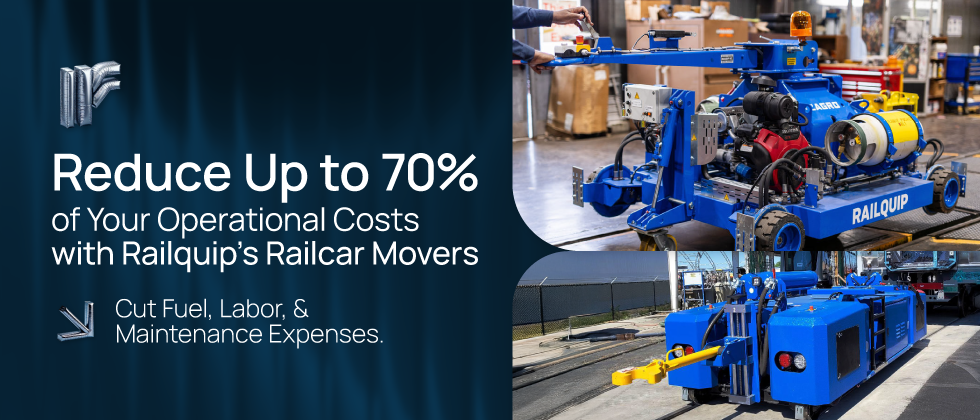
Railcar movers aren’t just a nice-to-have. They’re a serious financial upgrade.
We’ve worked with rail yards that were stuck in a cycle of high fuel costs, downtime, and constant maintenance all because a switcher locomotive felt like the default option.
But once they made the move to a Railquip railcar mover, everything changed. Operations got quieter. Repairs dropped off. Control improved. And suddenly, the budget wasn’t so tight. If you’re even thinking about making that shift, now’s the time to take a closer look.
Ready to see what that shift could look like for your operation? Start with the numbers. Download the E-Maxi M spec sheet to see the capabilities behind the mover. Then check out the full Railcar Movers brochure to compare models and decide what fits best.
And if you’d rather talk it through, we’re here to walk you through the ROI no pressure, just straight answers with the help from our experts.