Operating a railway crane is no small task. When you’re handling 100+ tons of steel on active rail lines, under electric wires, or inside tunnels, there’s zero room for error. It’s not just about lifting — it’s about doing it safely, precisely, and with full situational awareness.
At Railquip, we’ve seen firsthand what happens when rail crane safety is treated as an afterthought and we’ve spent decades building solutions that make safety a built-in feature, not an extra checkbox.
In this blog, we break down the core safety principles behind effective crane operation including real-world best practices, required certifications, and the most common preventable accidents. We’ll also give you a ready-to-use safety checklist that your team can apply on any rail project.
Let’s dive into what it really takes to operate a railway crane safely and why it all starts long before the first lift.
Why safety is non-negotiable in railway crane operations
Here’s the truth: every lift is a high-stakes operation. You’re not just moving a component, you’re moving it next to live rail traffic, in unpredictable weather, around workers on foot, and often with tight spatial clearance. One misstep can shut down an entire line, damage critical infrastructure, or worse put lives at risk.
That’s why safety needs to be more than a regulation. It needs to be a mindset.
At Railquip, we design our railway cranes including our 172-ton telescopic models with safety baked into every feature. We’re talking built-in load stability systems, emergency braking options, and custom designs that keep the crane’s center of gravity balanced, even on curves or uneven terrain
But even the best equipment can’t compensate for poor planning or inadequate training. Real crane safety is a combination of smart technology, operator awareness, and a culture that puts people first. You can’t just rely on machinery — you need protocols, teamwork, and discipline.
And if you’re running rail projects across bridges, tunnels, substations, or trackside areas? That safety culture it’s non-negotiable.
What safety precautions should be followed for railway crane operations?
Before you even think about engaging the controls, crane safety starts with preparation and we’re not just talking about glancing at a checklist.
Railway environments introduce variables that other lifting jobs don’t: electrified catenaries, uneven ballast, limited maneuvering space, and live rail traffic. So your safety protocols need to go far beyond standard jobsite procedures.
Here’s what a safe setup actually looks like in the field:
- Do a full job hazard analysis
Every site is different. Are there overhead lines? Sloped rails? Tight clearance? You need to plan around the actual environment, not just what’s on paper. - Check your equipment every shift
Inspect brakes, hydraulics, outriggers (if applicable), tilt indicators, load sensors, and communication tools. Even one missed warning light could become a hazard. - Define your communication protocols
Use hand signals or headsets just to make sure everyone knows the plan before anything lifts. Miscommunication is one of the most common causes of crane-related incidents. - Confirm the lift plan
Everyone on the team should understand the weight, the pick points, the path of travel, and the drop location. No assumptions. No improvisation mid-lift. - Establish safety zones
Physically mark and enforce the buffer area around the crane and the load path. No wandering crews, no spectators, only authorized personnel in the danger zone.
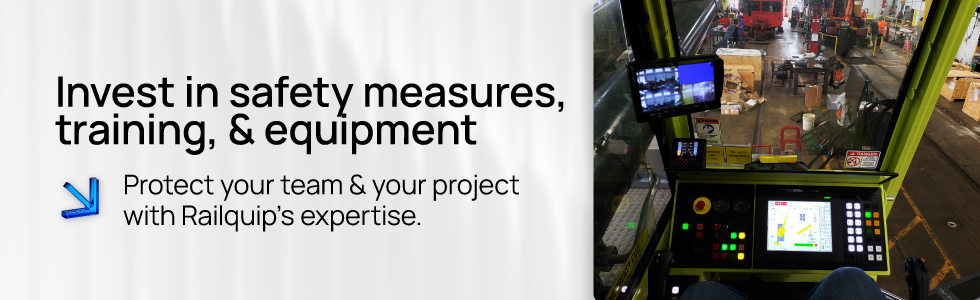
At Railquip, our cranes come equipped with built-in safety enhancements that support this kind of disciplined setup: real-time stability feedback, load monitoring, and precision controls to help operators stay in control under pressure.
What certifications are required for crane operators?
You can’t operate a crane on or near railroad tracks without the right credentials and for good reason.
These machines are powerful, complex, and often customized for unique work zones. A trained operator isn’t just better at their job, they’re better at protecting the people around them.
Here’s what the law, and common sense, requires:
- NCCCO (National Commission for the Certification of Crane Operators)
This is the gold standard. NCCCO ensures your operator understands rigging, signaling, load dynamics, and emergency procedures. - ASME B30.5 standards knowledge
Mobile and locomotive cranes fall under this set of engineering and safety guidelines. Operators should be fluent in its principles. - Site-specific training
If you’re operating on transit-owned tracks (like Amtrak or BART), you may need additional clearance, especially for work inside tunnels, on bridges, or under live catenary. - Hands-on training with the actual crane model
It’s not enough to be certified — operators should train on the specific controls and systems they’ll be using. Especially when working with custom or modified cranes like those Railquip delivers. - Ongoing recertification
Certification isn’t one-and-done. Regular retraining is critical to ensure skills stay sharp and updated with evolving equipment and regulations.
Bottom line: an uncertified operator is a risk you can’t afford and Railquip assists in the onboarding process by providing technical documentation and safety guides specific to the crane system being delivered, helping your teams meet and maintain certification requirements with confidence.You can’t operate a crane on or near railroad tracks without the right credentials and for good reason.
These machines are powerful, complex, and often customized for unique work zones. A trained operator isn’t just better at their job, they’re better at protecting the people around them.
Here’s what the law, and common sense, requires:
- NCCCO (National Commission for the Certification of Crane Operators)
This is the gold standard. NCCCO ensures your operator understands rigging, signaling, load dynamics, and emergency procedures. - ASME B30.5 standards knowledge
Mobile and locomotive cranes fall under this set of engineering and safety guidelines. Operators should be fluent in its principles. - Site-specific training
If you’re operating on transit-owned tracks (like Amtrak or BART), you may need additional clearance, especially for work inside tunnels, on bridges, or under live catenary. - Hands-on training with the actual crane model
It’s not enough to be certified — operators should train on the specific controls and systems they’ll be using. Especially when working with custom or modified cranes like those Railquip delivers. - Ongoing recertification
Certification isn’t one-and-done. Regular retraining is critical to ensure skills stay sharp and updated with evolving equipment and regulations.
Bottom line: an uncertified operator is a risk you can’t afford and Railquip assists in the onboarding process by providing technical documentation and safety guides specific to the crane system being delivered, helping your teams meet and maintain certification requirements with confidence.
What are the most common accidents and how can they be prevented?
Most crane accidents don’t happen because of some rare, freak event. They happen because of small missteps that were overlooked or rushed. When you’re working in tight, high-risk rail environments, there’s no room for shortcuts.
Here are the top incident types and how to stay ahead of them:
- Tip-overs from unbalanced loads
- Always confirm weight and center of gravity
- Use load charts, not guesswork
- Deploy any outriggers or stabilizers correctly
- Trust your onboard load monitoring systems
- Striking personnel or equipment
- Set and enforce exclusion zones
- Make sure the spotter and operator maintain clear lines of communication
- Keep ground crews visible and informed at all times
- Contact with overhead power lines
- Measure your clearance before setup
- Use a designated signal person for lifts near catenary
- Railquip’s cranes are built for maneuvering under electric lines — but operator awareness is still key
- Hydraulic or mechanical failure mid-lift
- This is where preventive maintenance matters. Replace worn parts before they become critical
- Never ignore minor faults — log and investigate them
- Fatigue-related judgment errors
- Schedule regular breaks
- Rotate operators on long jobs
- Use checklists to reduce cognitive overload
A safe operation is rarely dramatic. It’s methodical, planned, and uneventful — exactly the way it should be.
Are railway cranes subject to specific U.S. regulations?
Absolutely! and the regulatory landscape is layered. If you’re working near rail infrastructure, it’s not just about following OSHA. You also need to align with FRA (Federal Railroad Administration) rules, ASME engineering standards, and often, local transit authority requirements.
Let’s break it down:
- OSHA 1926 Subpart CC
This regulation governs the use of cranes in construction settings. It covers everything from ground stability to power line clearance, and it sets clear expectations for operator qualifications, signaling, and equipment condition.
- FRA oversight
Any crane operating near live tracks or within the railroad right-of-way must follow FRA rules — particularly when equipment is used during active train service windows.
- ASME B30.5
This standard applies to mobile and locomotive cranes. It outlines critical load management practices, equipment limitations, and safety protocols specific to the rail environment
- Transit authority rules (Amtrak, MTA, etc.)
These agencies often add additional safety or clearance requirements, especially when cranes are used inside tunnels or on bridges. For example, in the AMTRAK NY Penn Station rehabilitation, Railquip custom-designed a 110-ton railbound tunnel crane that could operate safely under catenary within confined urban clearances.
The key takeaway? You can’t just check one box. Compliance is multi-layered and Railquip builds every crane with that complexity in mind. Our engineering team works closely with clients to meet not only performance goals, but every safety and regulatory requirement from day one.
Is operator training mandatory?
There’s no gray area here: yes, operator training is mandatory and not just for legal compliance, but for real-world safety and performance.
Every crane operator working in a rail environment should be trained, certified, and regularly assessed. But beyond that, the best teams treat training as an ongoing part of their safety culture.
What effective crane training should include:
- Formal certification (NCCCO or equivalent), plus any additional local or agency credentials
- Hands-on training with the specific crane model and control system
(especially important for customized or high-capacity cranes) - Environmental risk training, such as working under electric lines, on curves, or in tunnels
- Emergency procedure drills, including failed lifts and sudden weather events
- Team-based communication protocols, so operators, riggers, and spotters all speak the same language
Railquip supports our customers with documentation, system walkthroughs, and maintenance and inspection guides tailored to each crane we deliver.
Railway crane safety checklist (and how to use it)
A checklist only works if it’s used and used correctly. Ours is designed to be straightforward, effective, and easy to apply no matter where your crane is deployed.
Pre-Operation Checklist
- Certified operator present
- Crane inspection completed (brakes, hydraulics, controls, sensors)
- Lift plan reviewed and approved by all team leads
- Ground crew briefed and safety zones clearly marked
- Site-specific hazards identified (overhead wires, uneven terrain, rail traffic)
- Emergency stop system tested
- Load weight and center of gravity confirmed
- Communication devices tested and in use
- PPE worn by all crew (helmets, vests, gloves, etc.)
- Weather conditions checked and within operational limits
You should treat this checklist the way pilots treat theirs: every time, no exceptions. Assign someone to it. Keep it visible.
Make it part of your start-of-shift routine. Because the moment something goes wrong is the moment you’ll wish it was followed.
Safety isn’t a feature, it’s a foundation
At Railquip, we don’t treat safety as an “extra.” It’s embedded in every product we build and every spec we deliver. From structural reinforcements to intuitive control panels, every detail is designed with the operator and everyone around the machine in mind.
But safety doesn’t stop at design. It requires a commitment from your whole team: planners, operators, spotters, and supervisors. It’s about building a culture where protocols are followed, voices are heard, and no one cuts corners to save time.
Railway cranes have one job: to lift heavy things in risky places. Our job is to make sure they do it safely, every single time.
Let’s build safer lifting operations together
If your operation involves lifting near tracks, tunnels, or electrified systems, you already know what’s at stake. You need crane systems that won’t compromise on safety and a partner that supports your crew long after installation.
With Railquip, you get:
- Railway cranes built for 172-ton capacity and tough jobsite conditions
- Safety-first designs with stability control, real-time monitoring, and tunnel-rated specs
- Support that goes beyond the machine from training to documentation to preventive service
Let’s take the risk out of heavy lifting. Let’s protect your people and your projects.
Talk to Railquip today and see how we build rail crane systems that raise the bar, not just the load.