Table of contents
- A rail crane mistake can cost far more than the right crane ever would
- Mistake #1: Choosing the wrong crane capacity for the load
- Mistake #2: Ignoring site limitations and rail layout
- Mistake #3: Overlooking maintenance and lifecycle costs
- How to make the right choice and avoid costly surprises later
- Frequently Asked Questions
A rail crane mistake can cost far more than the right crane ever would
Choosing the wrong rail crane might not show its consequences on day one, but eventually, the gap between what your operation needs and what your crane can deliver becomes impossible to ignore.
Overload risks, performance limitations, mounting maintenance costs, and site inefficiencies all trace back to poor initial selection.
The irony? These issues are usually avoidable. Most stem from decisions made too early, with too little information, or based on the wrong criteria, like focusing only on purchase price or assuming one crane can fit any rail application.
If you’re an engineer, supervisor, or procurement lead tasked with selecting lifting equipment for railway operations, this guide is for you.
Below, we’ll explore three of the most common, and costly, mistakes in rail crane selection, along with the practical steps you can take to avoid them from the start.
Mistake #1: Choosing the wrong crane capacity for the load
One of the most frequent and dangerous mistakes in rail crane procurement is underestimating the true load demands of the job.
On paper, a crane might appear to meet your maximum weight requirements. But real-world conditions often expose mismatches between what the crane is rated to do and what it’s actually asked to perform, especially over time, across variable load cases, and under pressure.
Railway cranes face highly dynamic lifting conditions. It’s not just about static weight, it’s about how that weight shifts, how forces are distributed across the boom and tracks, and how frequently the equipment is expected to lift, travel, rotate, and reset.
Undersizing a crane may lead to:
- Structural stress or early fatigue in the boom, undercarriage, or turntable
- System shutdowns triggered by overload sensors during critical lifts
- Increased cycle times due to cautious or partial lifts
- Operational restrictions (e.g. limited radius or reduced lift height under certain loads)
- Higher risk of failure during emergency recovery or unexpected load scenarios
Even oversizing has its own costs like higher upfront investment, greater footprint, and more complex logistics. But undersizing? That’s where safety, performance, and cost efficiency are all compromised at once.
A safe way to avoid it is to go beyond the nameplate. Selecting the right crane capacity requires a more comprehensive assessment than just matching maximum lift weight. Here’s what to include:
- Understand your load spectrum: What’s the full range of objects you’ll lift — from minimum to worst-case? Are there asymmetrical loads, multi-axle lifts, or components with shifting centres of gravity?
- Use the full Load Chart — not just the headline number: Cranes have different capacities depending on boom angle, radius, and track alignment. A 30-ton crane at minimum radius might only offer 12 tons at full extension. Check performance at all working positions.
- Factor in dynamic conditions: Include margin for wind, incline, emergency lifts, or recovery operations. Many rail scenarios don’t allow perfect alignment or level ground.
- Ask for technical support or a simulation: A qualified supplier should offer real-world simulations based on your site specs and lifting plan. If they can’t? That’s a red flag.
In short: capacity mistakes don’t just cause delays. They damage equipment, create safety risks, and erode long-term ROI. But with proper assessment, they’re 100% preventable.
Mistake #2: Ignoring site limitations and rail layout
Even the best crane on paper can become a problem on site if it doesn’t fit, or worse, if it disrupts more than it helps.
A common oversight during crane selection is focusing on lifting specs without fully accounting for the actual working environment. In rail operations, where space is often tight and infrastructure is fixed, overlooking site conditions can reduce efficiency, increase risk, and cause costly project delays.
Given that a rail crane doesn’t operate in isolation. It works within an ecosystem full of tracks, yards, switches, maintenance depots, clearance zones, overhead lines, nearby assets, all of which constrain or enable its use.
Problems that often arise include:
- Insufficient space for turning or slewing: If the crane’s boom radius or counterweight swing exceeds available clearance, operations become restricted or unsafe.
- Blocked access to key lifting points: Some rail yards don’t allow ideal alignment between crane and load due to adjacent lines, fencing, or support infrastructure.
- Track limitations: The condition, gauge, and layout of rails may limit crane travel, especially for mobile rail cranes. Poor alignment can lead to derailment or instability.
- Unexpected obstructions: Overhead wiring, support columns, or utility lines can all interfere with crane operation if not accounted for in the planning phase.
In short, the perfect crane in the wrong environment becomes a liability, one that can bring work to a crawl or force costly reconfiguration of the site.
How to avoid it: Plan for space, movement, and terrain
- Conduct a full site analysis before procurement: Map all working areas, adjacent infrastructure, and travel paths. Pay special attention to radius limitations, swing zones, and track gradients.
- Involve engineering and operations teams early: Don’t leave layout consideration to procurement alone. Technicians and site supervisors often know where bottlenecks or interference risks lie.
- Consider custom rail-mounted solutions: For sites with predictable layouts, customisable fixed-track cranes or trolley-mounted systems can optimise lift coverage without introducing access conflicts.
- Simulate crane movement digitally: Ask your supplier for CAD models or 3D simulations to test the crane in your actual site layout. This helps identify spatial conflicts before they become real problems.
Operational efficiency isn’t just about power, it’s about precision within space. And the earlier you match your crane to your site realities, the smoother your project will run.
Mistake #3: Overlooking maintenance and lifecycle costs
Price is important but it’s rarely the full story. Many procurement decisions are made based on upfront capital expenditure, with too little weight given to the total cost of ownership over the crane’s operational lifespan. That’s a mistake that can quickly flip a “low-cost” crane into a high-expense burden.
In the rail industry, where lifting equipment is subject to heavy usage, demanding environments, and long service cycles — failing to account for maintenance, parts, and support can mean chronic downtime, rising repair bills, and diminished ROI.
A crane that’s slightly cheaper up front may end up costing significantly more in the long run due to:
- Frequent breakdowns requiring unscheduled repairs
- Unplanned component replacements due to low-grade materials or poor design
- Lack of local parts availability, forcing extended downtime while waiting for shipments
- Specialist-only service requirements that increase technician costs and scheduling delays
- Incompatibility with predictive maintenance systems, leaving crews to rely on reactive fixes
In contrast, investing in a crane designed for durability and supported by a strong service network results in fewer disruptions, lower maintenance costs, and safer, more predictable operations.
How to avoid it: Look beyond the quote
- Assess lifecycle cost, not just purchase price: Ask your supplier for total cost of ownership projections — including expected service intervals, part replacement schedules, and operating costs.
- Ask about support infrastructure: Do they have parts stocked in your region? Are local technicians certified for service? Can they respond within a defined window?
- Evaluate service access and diagnostics: Modern rail cranes should include integrated diagnostics and remote monitoring. This helps crews identify issues early and plan maintenance around operations, not the other way around.
- Consider maintenance agreements: Some suppliers offer long-term service contracts or predictive maintenance programs that lock in cost and improve reliability.
Procurement isn’t just a purchase, it’s a partnership. Choose a crane supplier that backs its product with ongoing support, smart diagnostics, and a commitment to keeping your operations moving.
How to make the right choice and avoid costly surprises later
Selecting the right rail crane involves more than just comparing specs, it also means understanding your full operational picture.
Load demands, site layout, long-term maintenance, and supplier support all play a critical role in determining whether your crane becomes a long-term asset or a recurring obstacle.
The good news? These mistakes are preventable. With the right technical input and planning, you can make a confident, informed decision that serves your operation for years, not just months.
Key recommendations to get it right:
- Involve your technical team early: Don’t leave the decision to procurement alone. Bring in engineers, operators, and maintenance staff to evaluate requirements and risks from multiple angles.
- Validate the supplier’s track record: Look for proven experience in railway applications — especially if your operation involves unique loading conditions, fleet types, or environmental challenges.
- Request simulations, site visits, or layout analysis: A trusted supplier should offer hands-on consultation, CAD layout assessments, or lifting simulations to ensure full alignment with your needs.
- Plan beyond the install: Ask about warranty terms, availability of local service, and ongoing technical support. Your crane is only as reliable as the ecosystem behind it.
Need guidance on your next rail crane investment? Let’s talk
At Railquip, we’ve helped clients across North America design, select, and install high-performance rail crane systems tailored to their operational realities, not just their spec sheets.
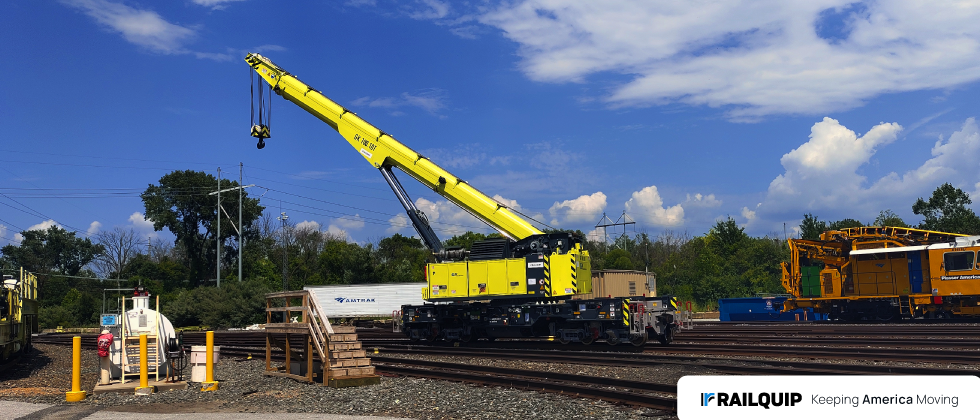
Whether you need a mobile crane for recovery work, a fixed-track system for yard operations, or a custom solution for a complex site, our team is here to help. Connect with Railquip’s technical experts today at railquip.com and get it right the first time.
Frequently Asked Questions
What certifications or safety standards should I look for in a rail crane?
Look for cranes that comply with key U.S. safety standards, such as ASME B30.2 (Overhead and Gantry Cranes), ASME B30.5 (Mobile and Locomotive Cranes), and applicable OSHA regulations (29 CFR 1910 and 1926). These standards cover critical aspects of design, load testing, maintenance, and safe operation specific to rail and industrial lifting equipment.
Can a rail crane be relocated or repurposed if our operations change in the future?
Many cranes can be adapted or relocated with the right planning. Discuss future flexibility with Railquip expert team to ensure your investment remains valuable even as site needs evolve.
What environmental conditions should be considered when selecting a rail crane?
Extreme temperatures, humidity, dust, or corrosive environments can all impact crane performance and maintenance needs. Proper material selection and protective coatings help extend service life.